Traditional corporate learning models produce certificates.
Workforce Micro-Credential Ecosystems produce capability signals that are directly consumable by staffing, deployment, and workforce planning systems.
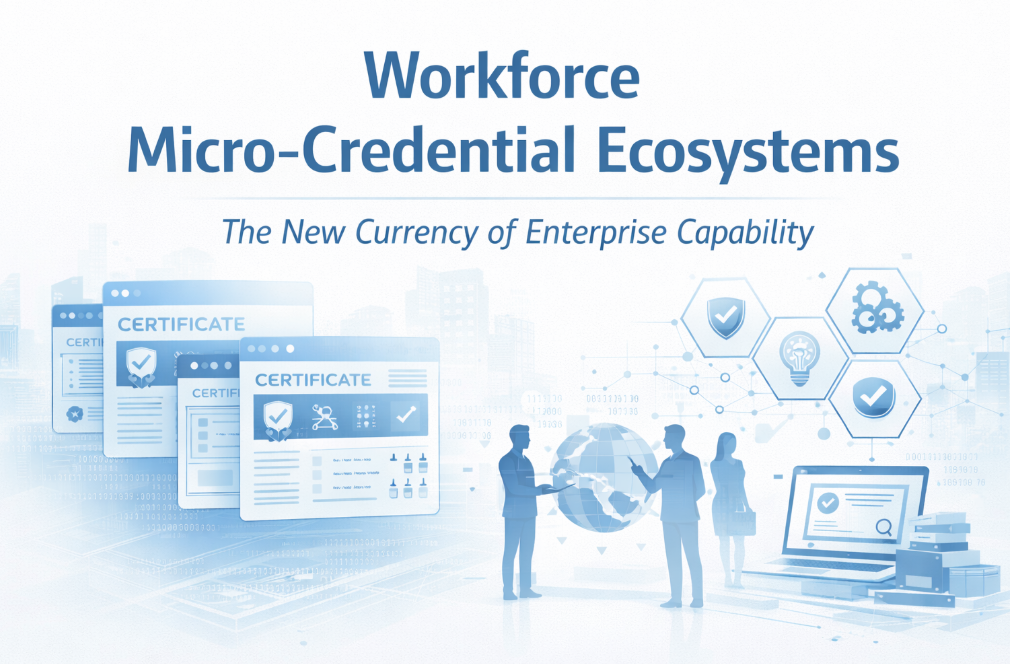
Instead of measuring learning attendance, enterprises now track:
- validated task-level proficiency
- skill adjacency proof points
- delivery-context performance signatures
- learning-to-deployment conversion velocity
Across GCCs, IT services, and transformation programs, Workforce Micro-Credential Ecosystems are emerging as the new currency of credibility — particularly in environments where skill half-life is shrinking and lateral hiring cannot keep up with emerging capability needs.
According to enterprise learning benchmarks across BFSI and tech services portfolios, organizations adopting Workforce Micro-Credential Ecosystems reported:
- up to 22% faster redeployment turnaround
- stronger alignment between learning & staffing demand
- measurable reduction in hiring duplication
Because capability is no longer “claimed” — it is verified through performance artifacts.
Internal Mobility Powered by Workforce Micro-Credential Ecosystems
Static role-based career ladders create skill silos.
Workforce Micro-Credential Ecosystems unlock capability mobility.
Instead of promoting employees only through tenure or designation bands, leading enterprises now use:
- stackable skill micro-credentials
- cross-pod contribution credits
- stretch-role capability validations
- delivery outcome-aligned proficiency tiers
This enables internal talent to move across:
- AI orchestration pods
- automation-first delivery environments
- cloud modernization squads
- analytics & simulation workstreams
Several Indian GCCs report that Workforce Micro-Credential Ecosystems helped shift legacy workforce segments into future-stack roles without productivity lag — a transition that would have otherwise required expensive lateral hiring cycles.
Deployment Readiness in Workforce Micro-Credential Ecosystems
Staffing leaders increasingly ask:
“Can this person perform in this environment — now — not after 3 months of ramp-up?”
Workforce Micro-Credential Ecosystems operationalize this through deployment-readiness scoring models that track:
- performance-at-first-assignment
- collaboration and delivery resilience
- proficiency decay curves
- environment-fit confidence bands
This allows HR and delivery leadership to differentiate between:
- credentialed learners
- deployable contributors
In program-heavy transformation portfolios, this distinction has reduced post-deployment productivity shock and minimized escalation risk during critical delivery phases.
Market Signaling & External Benchmarking in Workforce Micro-Credential Ecosystems
High-maturity HR organizations are extending Workforce Micro-Credential Ecosystems beyond internal training platforms and integrating them with:
- industry credential frameworks
- role-cluster wage benchmarks
- talent marketplace matching engines
This creates a verifiable signal for:
- niche technical credibility
- domain pathway competency
- emerging stack specialization
Global talent initiatives in engineering R&D hubs have demonstrated that Workforce Micro-Credential Ecosystems increase retention probability where career growth is anchored to visible capability progression rather than title inflation.
Employees stay — not because they are paid more — but because capability growth becomes legible, portable, and economically meaningful.
Governance & Trust Architecture in Workforce Micro-Credential Ecosystems
Scaling Workforce Micro-Credential Ecosystems requires institutional trust.
High-governance models embed:
- transparent assessment rubrics
- dual validation (mentor + delivery environment)
- bias-safe scoring workflows
- auditable capability trails
Without this governance layer, micro-credentials risk being perceived as symbolic rather than structural.
In successful implementations, employees treat credentials as:
- proof of contribution
- leverage for internal mobility
- currency inside staffing conversations
because capability becomes measurable — and therefore negotiable.
Where Workforce Micro-Credential Ecosystems Create Highest ROI
The strongest returns appear in environments with:
- high technology turnover
- rapid team restructuring
- multi-pod delivery ecosystems
- continuous reprioritization cycles
Enterprise use cases include:
- AI transformation squads validating prompt-ops proficiency
- cloud modernization programs verifying migration readiness
- automation teams credentialing workflow-engineering tracks
Across these scenarios, Workforce Micro-Credential Ecosystems strengthen:
- deployment precision
- internal liquidity of talent
- learning-to-value conversion speed
The workforce stops being trained — it becomes continuously re-validated for relevance.








Post Comment