Most enterprises today operate inside fragmented workforce tech stacks — ATS systems hold hiring data, LMS platforms track learning progress, productivity tools archive delivery outcomes, and HRIS databases store compensation and role metadata. The result is a workforce environment where capability exists, but visibility doesn’t. This is why Workforce Data Interoperability Frameworks are emerging as a critical foundation layer for enterprise HR modernization.
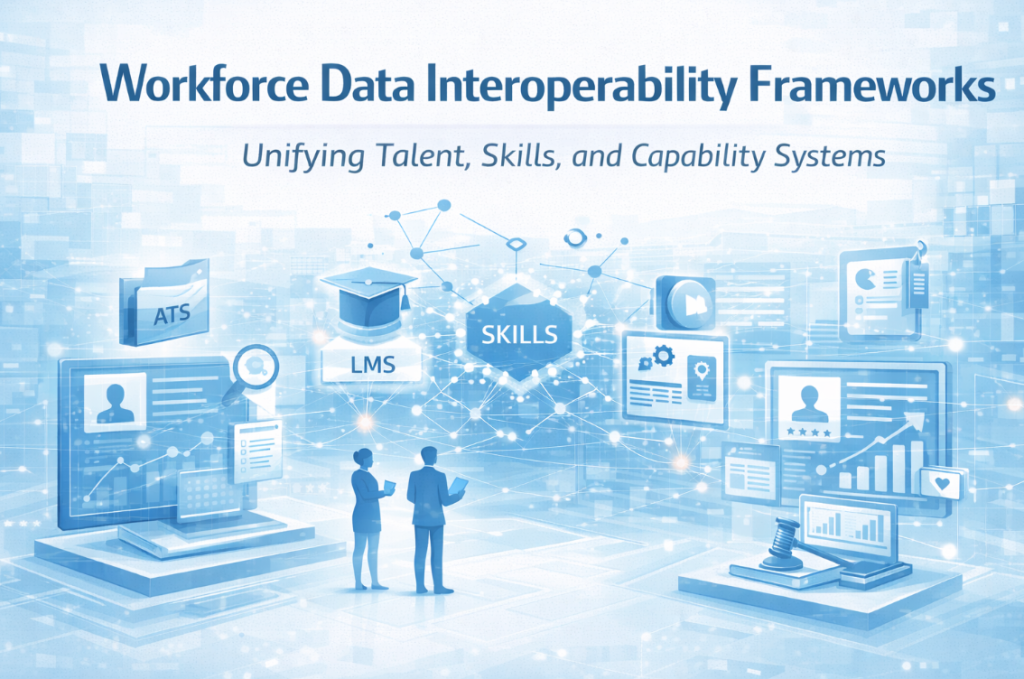
Instead of moving toward yet another monolithic HR platform, leading organizations are building Workforce Data Interoperability Frameworks that connect skills graphs, deployment histories, performance signals, learning pathways, and career mobility journeys into a unified capability layer.
Across GCCs, consulting delivery ecosystems, and global transformation programs, these frameworks are enabling HR leaders to shift from data ownership to capability intelligence orchestration — a far more strategic position in enterprise decision architecture.
Why Fragmented Workforce Systems Limit Capability Decisions
Technology adoption in HR has historically evolved in silos:
- ATS → optimized hiring workflows
- LMS → optimized learning experiences
- HRIS → optimized record management
- Productivity tools → optimized delivery visibility
Individually, each system performs well.
Collectively, they create decision blind spots.
Without Workforce Data Interoperability Frameworks, organizations cannot answer structurally important questions like:
- How does learning investment translate into deployment readiness?
- Which skills accelerate performance in specific delivery environments?
- Where does internal mobility create capability debt elsewhere?
- Which capability clusters generate real economic value?
Data exists everywhere — but meaning exists nowhere until systems can talk to each other.
Architecture Principles Behind Workforce Data Interoperability Frameworks
High-maturity enterprises are adopting architecture models built around:
- skills graph alignment instead of static skill tags
- event-based workforce signals instead of periodic reports
- entity relationship maps across roles, skills, and outcomes
- API-first integration instead of platform-locked data silos
Within Workforce Data Interoperability Frameworks, capability is treated as a networked object — not a record entry.
For example, an engineer is no longer seen as just:
designation + level + department
but instead as a living capability node with:
- adjacency skills
- learning velocity
- historical deployment impact
- collaboration resilience metrics
This creates a higher-resolution view of how capability behaves at scale, not just where it exist.
Use Cases Where Workforce Data Interoperability Creates Strategic Advantage
Organizations implementing Workforce Data Interoperability Frameworks report strongest value in:
Internal Mobility & Redeployment Precision
Leaders can finally see:
- which skills actually succeed in specific project contexts
- where talent can shift without productivity loss
- which teams absorb redeployment better than others
Internal movement becomes intentional — not experimental.
Skills-Linked Performance Intelligence
Instead of broad performance ratings, enterprises correlate:
- skills → outcomes
- environments → success probability
- learning → deployment impact
This enables capability-centric performance narratives, not role-centric ones.
Workforce Planning & Capability Forecastin
With interoperable data, planning shifts from headcount volume to:
- capability supply-demand balance
- emerging skill saturation points
- talent liquidity heat maps
- delivery fragility risk areas
Executives don’t just see how many people exist — they see what the organization can actually do.
Governance & Data Stewardship in Workforce Data Interoperability Frameworks
The success of Workforce Data Interoperability Frameworks is less about engineering complexity — and more about institutional governance maturity.
High-trust adoption models include:
- role-tiered data visibility boundaries
- consent-aligned usage policies
- cross-function ownership councils
- bias-safe capability interpretation rules
Because once capability intelligence becomes integrated,
the organization must also become accountable for how it uses it.
Where Enterprise HR Is Moving Next
The next evolution of HR technology will not be another all-in-one suite — it will be interconnected capability ecosystems.
Enterprises that invest in Workforce Data Interoperability Frameworks are building:
- richer visibility
- stronger mobility ecosystems
- higher-confidence workforce decisions
- sustainable capability advantage
In a world where skills decay faster than structures,
interoperability is becoming the true strategic infrastructure of HR.






Post Comment