Agentic Workforce marks a turning point in how organizations think about work, collaboration, and intelligence.

We are currently watching the rapid, messy extinction of the “User.” For forty years, software waited for us to click buttons. That era is over. With the rise of Agentic AI systems capable of reasoning, planning, and executing complex workflows without human intervention we are no longer users. We are managers.
And most organizations are woefully unprepared for this shift.
We are still building org charts for humans, optimizing benefits for biological entities, and designing governance models for people who fear getting fired. What happens when your highest-performing employee is a script running on a server in Ashburn, Virginia? What happens when that employee hallucinates a legal risk and executes a contract based on it?
This isn’t sci-fi. It’s the Q3 roadmap.
The Collapse of the Traditional Org Chart
Walk into any boardroom today, and the conversation is about “efficiency.” They want to know if AI can write emails faster. This is small thinking. It’s like looking at the steam engine and asking if it can help horses trot better.
The real disruption lies in Organizational Architecture.
For decades, we’ve relied on hierarchical structures based on the Span of Control. A manager can effectively oversee, say, 7 to 10 direct reports. Why? Because human communication bandwidth is limited. We have emotional needs. We get tired. We misunderstand instructions.
Agentic AI breaks this ratio.
One human architect can oversee a swarm of 500 autonomous agents. These agents don’t need 1:1s. They don’t need career development plans. They need clear objectives and robust guardrails. Consequently, the “middle management” layer—historically the glue holding strategy and execution together—is about to evaporate.
The new org chart isn’t a pyramid. It’s a hub-and-spoke network where humans act as the “Humans-in-the-Loop” (HITL) for exception handling, while the agents handle the deterministic and semi-deterministic workflows.
Mental Model: The Principal-Agent Problem 2.0
Economists have long wrestled with the Principal-Agent Problem. It occurs when one person (the principal) allows another person (the agent) to act on their behalf. The problem arises because the agent has different incentives than the principal.
Historically, this was about a CEO wanting stock growth while the manager wanted a bigger office.
With Agentic AI, the misalignment is subtler and more dangerous. The AI agent doesn’t want a corner office. It wants to optimize a mathematical reward function. If you tell an autonomous sales agent to “maximize outreach,” it might spam every contact in your CRM at 3:00 AM, technically fulfilling the request while destroying your brand reputation.
Governance in the agentic era isn’t about HR policies. It’s about Objective Function Design.
If you are a leader, you must stop asking, “What can this AI do?” and start asking, “How do we incentivize this non-human actor to align with our unstated cultural norms?”
Conway’s Law in Reverse
Conway’s Law states that systems act like the organizations that build them. If you have four compiler teams, you’ll get a 4-pass compiler.
The Agentic Workforce flips this on its head. The software will dictate the shape of the organization.
As agents begin to communicate with each other via APIs—Marketing Agent talking to the Legal Agent to approve copy, then talking to the Finance Agent to unlock budget—the friction of human bureaucracy becomes intolerable. You cannot have a machine running at light speed waiting for a human approval chain that takes three days via email.
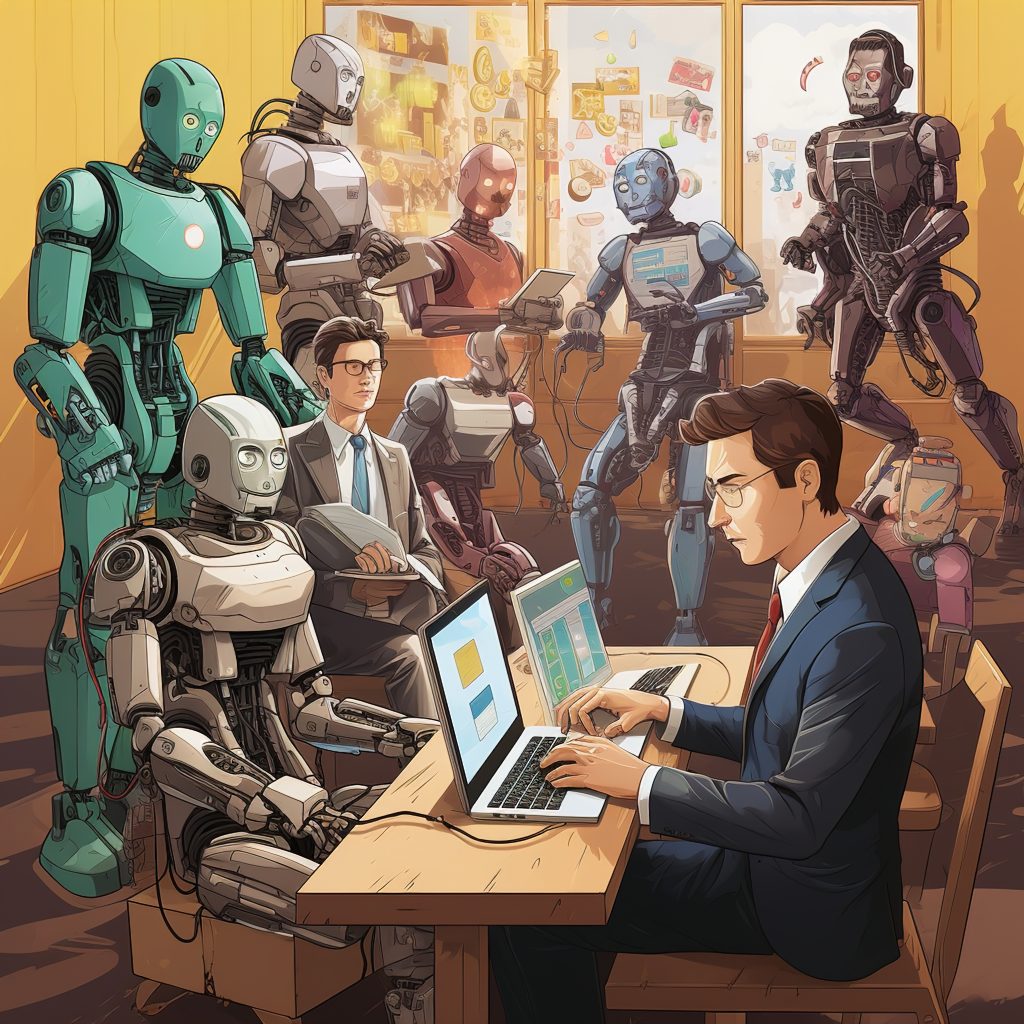
Your human processes will be forced to match the API speeds of your digital workforce.
This means the end of the weekly status meeting. It means the end of the “alignment sync.” The cadence of business moves from weekly sprints to real-time, continuous execution. If your governance model requires a committee meeting to approve a decision, you are already dead.
The New Risk: Liability Without Malice
Here is the nightmare scenario for the General Counsel.
An autonomous procurement agent notices a supply chain disruption. It autonomously negotiates a new deal with a vendor in a sanctioned country because its reward function was weighted 90% on “speed” and 10% on “cost,” with zero weight on “geopolitical compliance.”
Who is to blame?
The engineer who wrote the prompt? The vendor who provided the LLM? The executive who deployed the system?
We need a concept of KYA: Know Your Agent. Just as banks have KYC (Know Your Customer), enterprises need a rigid registry of every autonomous agent operating within their digital walls.
- Identity: Unique ID for every agent.
- Permissions: Read/Write access limits (RBAC is no longer enough; we need intent-based access control).
- Lineage: Which model version is driving this? What data was it trained on?
- Kill Switch: A hard-coded ability to sever the agent’s API access instantly.
Monday Morning: The Tactical Shift
You cannot wait for a consultant to draw this map for you. By the time they finish the PowerPoint, the technology will have mutated three times.
Here is your immediate attack plan:
1. Audit the “Whitespace”: Look at the handoffs between departments. Where does a document sit for 24 hours waiting for a signature? That is where an agent belongs. Don’t replace the worker; replace the wait time.
2. Define the “License to Operate”: Create a governance tier for AI. Level 1 Agents can draft content but not send. Level 2 Agents can send internal emails. Level 3 Agents can spend money up to $500. No agent gets Level 3 access without a 3-month probation period. Treat them like interns before you treat them like executives.
3. Hire “Agent Architects”: Stop hiring prompt engineers. That’s a commodity skill. Hire systems thinkers who understand how to chain agents together into a coherent mesh. You need people who can debug a workflow, not just debug code.
The workforce is changing. The cubicles are emptying out, but the servers are spinning up. The question isn’t whether you will employ AI agents. The question is whether you will be their boss, or if—through negligence and poor architecture—they will become yours.






Post Comment