The next wave of enterprise workforce transformation is being driven by Skills-Based Staffing Architecture, where hiring, deployment, and capability mapping shift away from rigid job roles and toward fluid, skills-centric value networks.
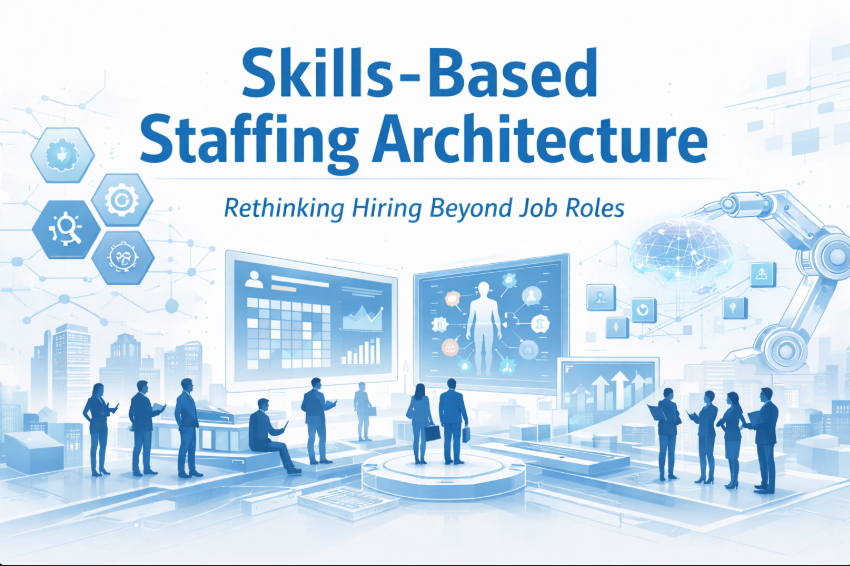
In high-maturity HR environments — especially GCCs, IT services, and engineering R&D — talent demand is no longer defined by titles like Senior Analyst or Project Lead. Instead, enterprises are designing Skills-Based Staffing Architecture models that map:
- micro-skills and adjacency clusters
- delivery-context performance patterns
- task-to-capability heatmaps
- redeployment and learning velocity curves
According to cross-industry transformation benchmarks, organizations that operationalized Skills-Based Staffing Architecture observed:
- 20–30% improvement in redeployment turnaround time
- significant compression in lateral hiring dependency
- measurable gains in internal mobility velocity
The shift is not cosmetic — it is structural. Workforce planning moves from headcount allocation to capability orchestration.
Skills-Based Staffing Architecture for Capability Mobility
Traditional org models treat employees as role occupants.
Skills-Based Staffing Architecture treats them as evolving capability nodes.
Instead of assigning people to departments, enterprises now map:
- outcomes delivered across prior assignments
- adjacent skills created through stretch roles
- skills half-life across technology stacks
- collaboration resilience inside delivery pods
This allows staffing leaders to unlock capability mobility — moving people across problem spaces without productivity loss.
In large Indian GCCs, Skills-Based Staffing Architecture has enabled:
- redeploying QA engineers into automation workflows
- shifting business analysts into product ops pods
- converting legacy tech talent into AI integration squads
This protects institutional knowledge while creating future-ready talent capacity — something lateral hiring alone cannot achieve.
Workforce Simulation in Skills-Based Staffing Architecture
The most advanced implementations of Skills-Based Staffing Architecture now integrate workforce simulation engines.
Instead of approving requisitions reactively, teams run:
- delivery-risk simulations
- capability sufficiency stress tests
- attrition shock modeling
- reskilling ROI forecasts
Before a large transformation deal is signed, HR and staffing leaders can simulate:
“If this program scales by 40%, which capability clusters collapse first?”
Multiple BFSI transformation programs report that Skills-Based Staffing Architecture surfaced hidden fragility in niche skill pods — allowing proactive upskilling and redeployment before performance degradation occurred.
This reframes workforce planning from forecasting to scenario-based resilience engineering.
Governance & Operating Model for Skills-Based Staffing Architecture
Scaling Skills-Based Staffing Architecture is not a tooling project — it is an operating model shift.
Enterprises that succeed embed:
- capability taxonomies instead of job families
- funding models for reskilling as capacity creation
- role-to-skill explainability layers for fairness
- joint governance between HR, COEs, and Delivery
Where governance maturity is weak, adoption collapses — not due to technology gaps, but due to cultural resistance to non-linear careers.
High-trust organizations deliberately institutionalize:
- transparent redeployment logic
- opportunity access parity
- audit trails for movement decisions
because capability mobility cannot thrive without workforce trust.
Use Cases Where Skills-Based Staffing Architecture Outperforms Role-Based Models
Real-world adoption shows the strongest ROI in environments with:
- rapid technology turnover
- multi-pod delivery ecosystems
- hybrid onshore–offshore models
- continuous reprioritization of work streams
Notable enterprise use cases include:
- Engineering R&D teams shifting from product lines to capability pools
- Cloud migration programs using reskilling corridors instead of hires
- Consulting delivery pods scaling via skills adjacency modules
In each case, Skills-Based Staffing Architecture improved:
- bench liquidity
- time-to-deployment
- learning-to-value conversion speed
The organization becomes structurally adaptive — not operationally reactive.
Where the Future of Staffing Is Heading
Enterprises that remain tied to role-based models will experience:
- hiring redundancy
- skill silos
- capability brittleness
Meanwhile, those building Skills-Based Staffing Architecture are designing:
- living capability ecosystems
- pathways for continuous redeployment
- workforce models that compound value creation over time
The winners in the next HR transformation cycle won’t be those with the largest headcount — but those with the most mobilizable capability architecture.






Post Comment