Most enterprises still scale hiring only after a project is signed, a program expands, or a delivery backlog becomes visible. By the time roles are raised, talent markets have already shifted, niche capability is scarce, and hiring lag bleeds into delivery readiness. This is exactly why Predictive Talent Pipeline Engineering is emerging as a strategic workforce discipline — enabling organizations to anticipate capability demand long before recruitment begins.
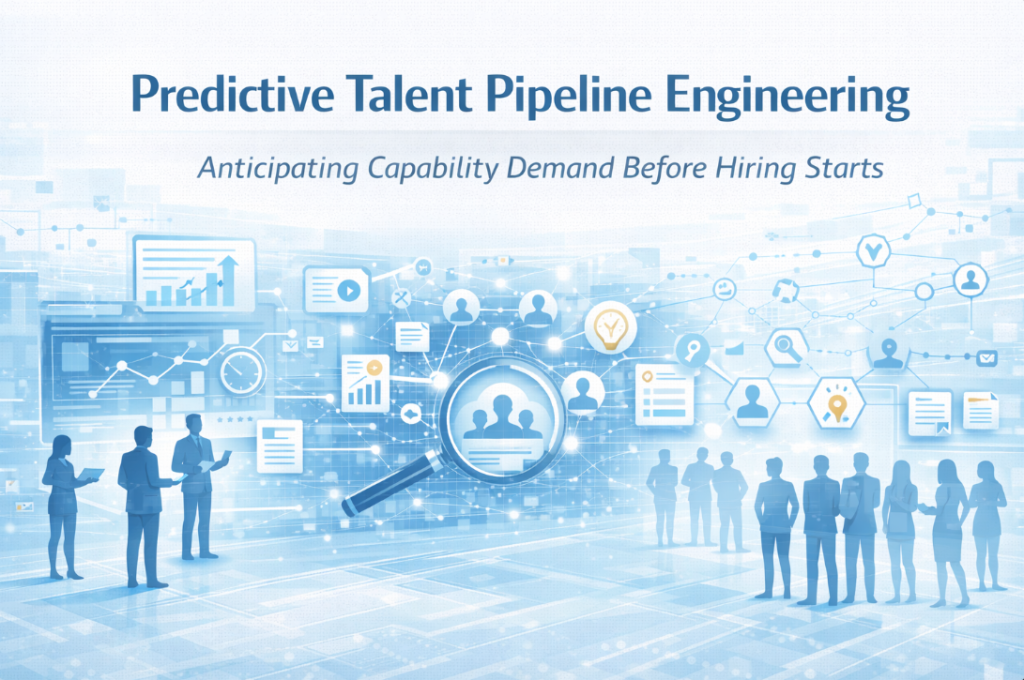
Instead of treating hiring as a fulfillment function, Predictive Talent Pipeline Engineering reframes it as a future-state capability design exercise — combining demand signals, skill adjacencies, learning velocity indicators, redeployment corridors, and market intelligence to architect pipelines before they are urgently required.
Across GCCs, consulting ecosystems, and engineering transformation programs, this shift is reducing dependence on last-minute lateral hiring while strengthening bench liquidity and deployment confidence.
Why Traditional Hiring Pipelines Fail Under Real Delivery Conditions
Conventional hiring pipelines assume:
- roles remain stable
- demand grows linearly
- capability risk is evenly distributed
In practice, enterprise environments experience:
- non-linear project ramp patterns
- niche-skill bottlenecks
- attrition shocks in capability clusters
- overlapping demand for the same talent band
The result is predictable:
- requisitions are raised late
- supply is already exhausted
- teams absorb productivity strain
- hiring decisions become price-biased instead of capability-led
Predictive Talent Pipeline Engineering addresses these stress points by modelling capability trajectories rather than vacancy counts.
Demand Signal Intelligence for Future Capability Mapping
High-maturity workforce teams are now aggregating early-stage demand signals such as:
- pre-sales probability curves
- early RFP capability language
- renewal-cycle restructuring patterns
- backlog compression indicators
- historical ramp-up signatures by domain
These signals feed into Predictive Talent Pipeline Engineering models that categorize capability requirements as:
- imminent
- emerging
- speculative
- strategic reserve
Instead of reacting to confirmed demand, enterprises begin shaping future supply readiness windows.
Skills Adjacency & Redeployment Pathways
A key advantage of Predictive Talent Pipeline Engineering is the shift away from role-specific sourcing toward adjacency-driven capability pathways.
Organizations evaluate:
- which internal clusters can pivot fastest
- where reskilling creates higher ROI than lateral hiring
- which delivery pods absorb capability transition better
- how learning investments accelerate pipeline maturity
This helps leaders decide:
“Do we hire this capability — or engineer it internally faster and safer?”
In several India-based engineering GCCs, adjacency-driven pipeline design has reduced external hiring dependency in niche tech stacks while preserving institutional knowledge.
Market Depth & External Ecosystem Readiness
Predictive pipelines extend beyond internal visibility.
Enterprises now layer:
- city-level skill availability
- wage-pressure inflection points
- partner-ecosystem supply maturity
- contractor readiness corridors
Instead of sourcing blind, HR and business leadership know:
- whether capability exists in the market
- how fast it can be secured
- and at what delivery risk exposure
This prevents organizations from committing to programs their ecosystem cannot realistically sustain.
Reducing Hiring Lag & Delivery Fragility
The strongest ROI from Predictive Talent Pipeline Engineering appears in:
- transformation portfolios with rolling ramp schedules
- multi-wave delivery environments
- capability-dense engineering programs
Outcomes reported include:
- shorter time-to-billable
- fewer emergency requisitions
- stronger first-wave deployment stability
- higher confidence during deal commitments
Hiring stops being a firefighting exercise —
it becomes a designed capability flow.
Governance & Operating Model Considerations
Predictive workforce programs succeed when they are institutionally owned — not HR-owned in isolation.
Mature operating environments include:
- shared leadership between HR, Delivery & COEs
- demand-signal review councils
- reskilling-vs-hiring decision matrices
- simulation-based pipeline investment approvals
Because every future-facing pipeline is not a cost —
it is a risk-hedging capability asset.
Enterprises that embed Predictive Talent Pipeline Engineering into planning cycles gain structural advantage — they see capability risk before it manifests and engineer readiness instead of reacting to scarcity.






Post Comment