As enterprises scale AI-powered hiring, deployment, and workforce intelligence platforms, Ethical AI Governance in HR Analytics is becoming a structural business requirement rather than a compliance afterthought. In high-stakes delivery environments, AI does not simply recommend candidates or predict attrition — it shapes opportunity access, compensation trajectories, and long-term workforce trust. That is why Ethical AI Governance in HR Analytics is now being embedded into operating models, not just policy documents.
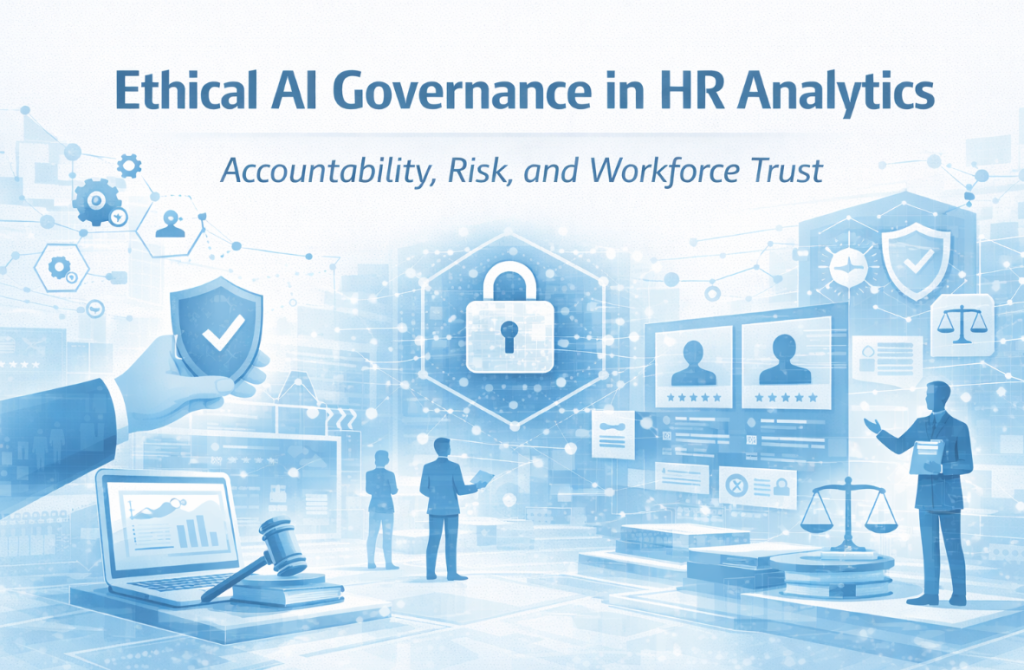
Across GCCs, consulting programs, and enterprise transformation portfolios, leaders are reframing AI from an automation technology into a decision accountability system — one that must remain explainable, auditable, and institutionally defensible.
Moving Beyond AI Compliance Checklists
Many HR functions initially approached AI adoption through compliance controls — bias scans, privacy notices, and template disclaimers.
But mature organizations are now recognizing that:
- compliance reduces risk exposure
- governance preserves legitimacy
- trust is an operational asset
Instead of asking whether a model is compliant, leaders now ask:
“Can this decision be explained, defended, and reproduced under review?”
This shift has accelerated the institutionalization of responsibility pathways — where legal, HR, business leadership, and delivery ecosystems jointly own AI outcomes rather than outsourcing accountability to tooling vendors.
Decision Explainability as an Operating Requirement
The most resilient enterprise programs are building explainability layers into HR analytics models, including:
- allocation reasoning trails
- override justification capture
- candidate evaluation transparency
- contextual decision annotations
In practice, this allows reviewers to reconstruct why a model surfaced a staffing recommendation — and how human judgment shaped the final deployment decision.
Case studies from BFSI and engineering GCCs show that when Ethical AI Governance in HR Analytics includes explainability logs, workforce pushback toward AI-enabled staffing dropped significantly, because decisions became interpretable rather than opaque.
Mitigating Institutional Bias and Capability Concentration Risks
Bias in HR analytics rarely originates inside the algorithm — it emerges from:
- historical staffing patterns
- capability silo concentration
- performance proxy distortions
- contextual blind spots
High-maturity teams now treat bias as a system behavior, not a statistical variance.
Governance models introduce:
- counterfactual model testing
- role-cluster equity reviews
- capability adjacency fairness checks
- long-term outcome monitoring
Instead of proving that a model is unbiased at deployment, organizations validate whether its decisions remain equitable over time and across workforce layers.
Human Oversight and Risk-Tiered Decision Gates
Rather than trying to automate everything, leaders are establishing risk-tiered oversight thresholds where:
- low-risk actions run through automated approval
- medium-risk actions require contextual review
- high-risk decisions mandate senior validation
This ensures that Ethical AI Governance in HR Analytics preserves human accountability where consequences are highest — particularly in:
- niche capability allocation
- compensation mapping
- leadership succession tracks
- redeployment after attrition shock events
Organizations adopting this model report higher leadership confidence in AI systems — not because accuracy improved, but because accountability became explicit.
Why Governance Is Becoming a Strategic Talent Advantage
Enterprises that institutionalize governance are discovering unexpected upside:
- stronger perception of fairness in internal mobility
- higher acceptance of AI-assisted staffing decisions
- improved audit resilience during client due-diligence
- faster model adoption with lower resistance friction
In global B2B environments, trust itself becomes a capability multiplier — enabling organizations to scale AI without eroding workforce confidence.
The future of HR analytics will not be defined by the sophistication of algorithms — but by the credibility architecture surrounding them.
And the enterprises that invest in Ethical AI Governance in HR Analytics will be the ones able to scale AI responsibly, sustainably, and with enduring institutional trust.






Post Comment