Enterprises operating large-scale delivery ecosystems increasingly rely on contractors, partner firms, and project-based external specialists — yet most organizations still manage them through spreadsheets, agency inboxes, and fragmented vendor management workflows. This is where Contingent Workforce Cloud Orchestration is emerging as a structural shift in how enterprises source, verify, deploy, and govern external capability across geographies and delivery programs.
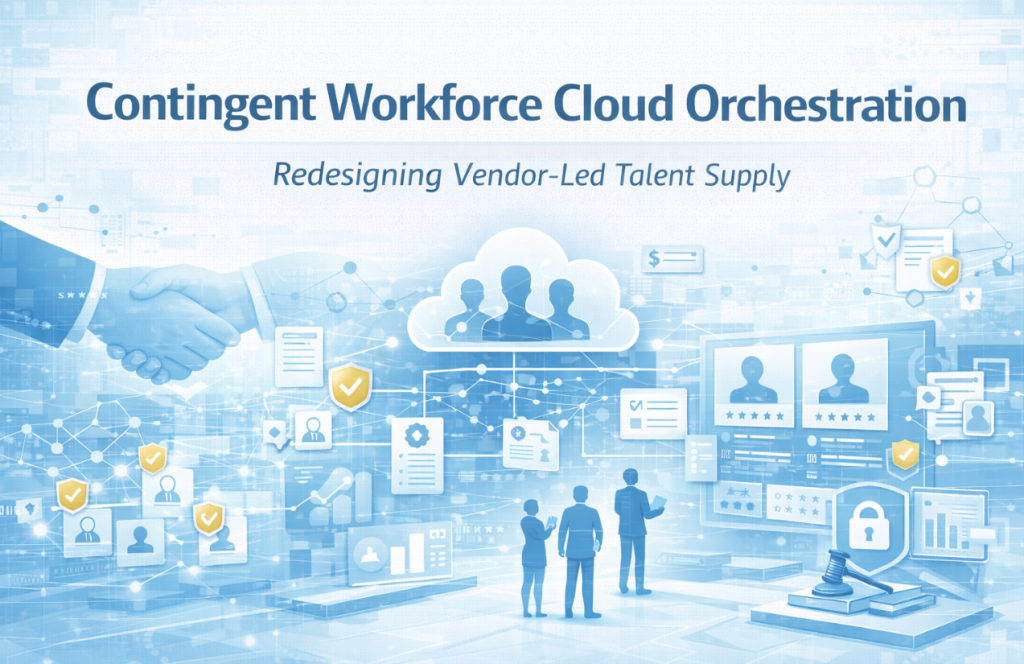
Rather than treating vendors as independent supply streams, Contingent Workforce Cloud Orchestration integrates partner ecosystems, contractor pipelines, deployment readiness signals, rate intelligence, and risk governance into a single orchestration layer — turning contingent talent from an ad-hoc acquisition channel into a scalable capability network.
Across GCCs, engineering services portfolios, and digital transformation programs, leaders are moving from tactical staffing fulfillment toward platform-mediated workforce liquidity — where external capacity becomes predictable, auditable, and strategically aligned.
Why Traditional Vendor Management Creates Structural Blind Spots
Conventional VMS and agency-driven workflows optimize procurement — not capability outcomes.
Common failure points include:
- duplicate vendor submissions for the same skill band
- non-standard screening and assessment quality
- opaque rate arbitrage across markets
- slow credential and compliance validation
- weak redeployment intelligence between programs
In high-stakes delivery environments, these gaps convert into:
- contractor ramp-time drag
- fragile role-dependency clusters
- unmanaged compliance exposure
- inconsistent capability depth across pods
Enterprises adopting Contingent Workforce Cloud Orchestration are reframing external hiring from transactional procurement to network-level capability engineering.
Platform-Layer Intelligence for External Talent Ecosystems
The most advanced orchestration models integrate:
- verified capability graphs for partner resources
- standardized evaluation & digital credential trails
- deployment readiness indicators
- project-context success correlation signals
This shifts selection logic from résumé matching to:
“Which contractor profile has historically sustained performance in this delivery environment?”
Several global engineering GCCs report that Contingent Workforce Cloud Orchestration reduced vendor screening variance and improved first-assignment delivery quality — especially where programs rely on niche or regional talent.
Rate Rationalization & Market Intelligence
Instead of rate cards negotiated in isolation, orchestration models introduce:
- skill-band wage intelligence across cities
- partner-level pricing transparency
- performance-weighted vendor scoring
- risk-adjusted total cost benchmarks
This allows leadership to distinguish between:
- low-rate suppliers with high stability risk
- value-aligned partners with stronger deployment outcomes
Organizations deploying Contingent Workforce Cloud Orchestration report fewer emergency escalations linked to “cheapest-bid staffing” — because price is evaluated alongside resilience and performance probability.
Compliance, Governance & Cross-Border Assurance
External workforce risk is no longer limited to contracts — it spans:
- data access exposure
- co-employment interpretation
- regulatory portability
- client audit readiness
High-maturity orchestration programs embed:
- jurisdiction-aware compliance rulebooks
- credential expiry & license monitoring
- audit traceability for talent movements
- vendor accountability escalation frameworks
In multi-country delivery hubs, this governance model has reduced audit friction while strengthening enterprise-wide trust architecture around contingent labor programs.
Redeployment Liquidity & Knowledge Preservation
One of the most underestimated advantages of Contingent Workforce Cloud Orchestration is the ability to preserve capability continuity across programs.
Instead of releasing proven contributors at project closure, orchestration engines surface:
- redeployment corridors inside adjacent programs
- opportunity bridges within the same skill lattice
- institutional knowledge retention pathways
This minimizes bench attrition risk while retaining ecosystem-level expertise that would otherwise exit the organization.
Where Contingent Workforce Cloud Orchestration Delivers Highest ROI
The strongest adoption outcomes appear in:
- program-heavy transformation portfolios
- multi-vendor delivery ecosystems
- niche skill sourcing across global markets
- high-regulation industry environments
Across these contexts, enterprises report gains in:
- time-to-deploy capability
- rate transparency discipline
- audit-ready workforce governance
- reduction in delivery fragility
Contingent labor is no longer an emergency supply channel —
it becomes a strategically orchestrated capability layer.







Post Comment