I have reviewed thousands of resumes across my career. I have sat on hiring panels, shortlisted candidates, and made the difficult call to reject profiles that belonged to genuinely talented people. And the most frustrating part of my job is knowing that most rejections are entirely avoidable.
At Impacteers, I want to change that.
This is not a generic checklist. This is an honest, experience-backed breakdown of the 25 resume mistakes I see repeatedly — mistakes that are quietly costing talented people the interviews they deserve.
Why Your Resume Is Not Getting Responses
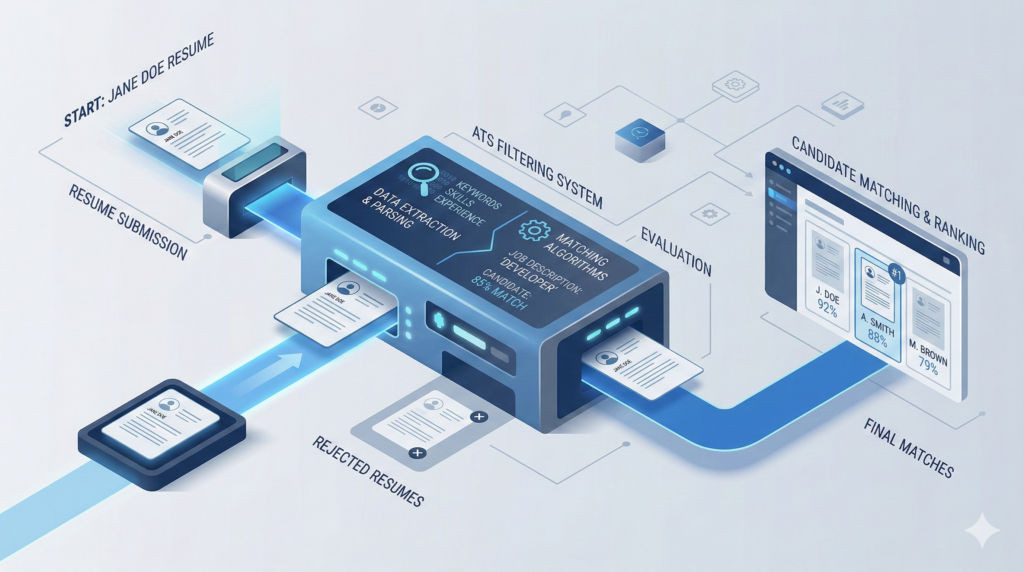
Here is the hard truth: recruiters spend an average of just 6–8 seconds reviewing a resume before deciding whether to move forward or move on. In those few seconds, your document must immediately communicate who you are, what you deliver, and why you are the right fit.
And even before a human sees your resume, an Applicant Tracking System (ATS) has already scanned, parsed, and scored it. Research shows that 75% of resumes are rejected by ATS before a recruiter ever reads them. Think about that for a moment. You could be the most qualified candidate in the pool and still never get a callback — simply because of a formatting issue or a missing keyword.
“I cannot tell you how many times I have seen a genuinely strong candidate fall through the cracks because their resume was not optimized for our systems. It is not about the person — it is about the document.”
— Senior HR Manager, Fortune 500 Tech Company
That is the reality of the 2026 job market. The good news? Every single one of these problems is fixable. Let us go through them together.
Critical Resume Mistakes That Kill Your Chances Instantly
These are the errors I catch in the first two seconds of reading a resume. If your document carries even two or three of these, your chances of making it to the interview stage drop dramatically.
1) Sending the Same Resume Everywhere
I understand the pressure of job searching. When you are applying to dozens of roles, the temptation to fire off the same document is real. But sending a generic resume to every job posting is one of the fastest ways to signal to a hiring manager that you are not genuinely interested in their role.
Every job description is a map. It tells you exactly what the company needs, which skills they prioritize, and the language their team uses internally. When your resume mirrors that language, it feels like a conversation. When it does not, it feels like spam.
The fix: Spend 10 minutes tailoring your summary and top three bullets to each application. Our step-by-step walkthrough on how to tailor your resume to a job description makes this process fast and repeatable. That small investment pays off significantly.
2) No Measurable Achievements
This is the single most common mistake I see, even from senior professionals. Resumes filled with responsibilities but zero results are invisible in a competitive pool.
Industry stat: Resumes that contain at least five quantified achievements generate a 40% higher callback rate than those without measurable outcomes.
Think about the difference between these two statements:
- “Managed a customer support team.”
- “Led a 12-member support team to achieve a 94% CSAT score, reducing average resolution time by 28% over two quarters.”
The second one tells me a story. It tells me you drove results, you measure your work, and you are results-oriented. That is the candidate I want to interview — for a full breakdown of formulas and examples, visit our guide on how to quantify resume achievements.
3) Spelling and Grammar Errors
I will be direct here: a typo on your resume is a red flag. It is not a small oversight. It tells me, in the very first interaction, that you may not have strong attention to detail — which is a core competency for almost every role.
Stat to know: 77% of hiring managers say they immediately disqualify candidates who submit resumes with grammatical mistakes.
Proofread. Read it aloud. Ask a trusted colleague to review it. There is genuinely no excuse for errors in a document you have complete control over.
4) Using a Generic Professional Summary
Your professional summary is prime real estate — it sits at the very top of your document and shapes everything a recruiter thinks about you in those first few seconds. A vague, generic summary like “Hardworking professional seeking a challenging role” communicates absolutely nothing.
A strong summary should answer three questions instantly:
- Who are you professionally?
- What specific value do you bring?
- Why are you the right fit for this role?
Write it last. Write it specifically. And rewrite it for every application — for role-specific templates you can copy, browse our resume summary examples library.
5) Listing Responsibilities Instead of Impact
Your job description tells me what you were supposed to do. Your resume should tell me what you actually achieved. There is a significant difference, and experienced hiring managers feel it immediately.
Move from task-based writing to outcome-based writing. Every bullet point should follow this structure:
Action Verb + What You Did + With What Context + Measurable Outcome
“When I review resumes, I am not looking for someone who can describe their last job. I am looking for someone who can tell me why their last company was better because they were there.”
— Impacteers Career Coach
6) Poor Formatting That Hurts Readability
A cluttered resume forces the recruiter to work hard to find your value. And recruiters, quite honestly, will not do that work. They will simply move on.
Clean formatting — consistent headings, adequate white space, standard fonts — accelerates the scan. It signals organizational clarity and professional maturity before you have said a single word about your skills.
7) No Keywords From the Job Description
ATS systems are programmed to search for specific terms derived directly from the job description. If your resume does not contain those terms in the right context, the system scores your profile as a low match — regardless of your actual qualifications.
This is not about keyword stuffing. It is about semantic alignment. Use the language the employer uses, in the context of real work you have done.
Before vs After: Impact Bullets in Action
| Before (Responsibility-Based) | After (Impact-Based) |
| Responsible for managing the content team. | Led a 6-member content team to grow organic traffic 58% in 6 months through a structured editorial calendar. |
| Helped with the customer onboarding process. | Redesigned onboarding flow for 3,000+ users, reducing drop-off by 34% and increasing 30-day retention. |
| Worked on sales outreach campaigns. | Executed 4 outbound campaigns targeting mid-market SaaS firms, generating $620K in qualified pipeline. |
Mini Case Study — What Changed, What Happened Next
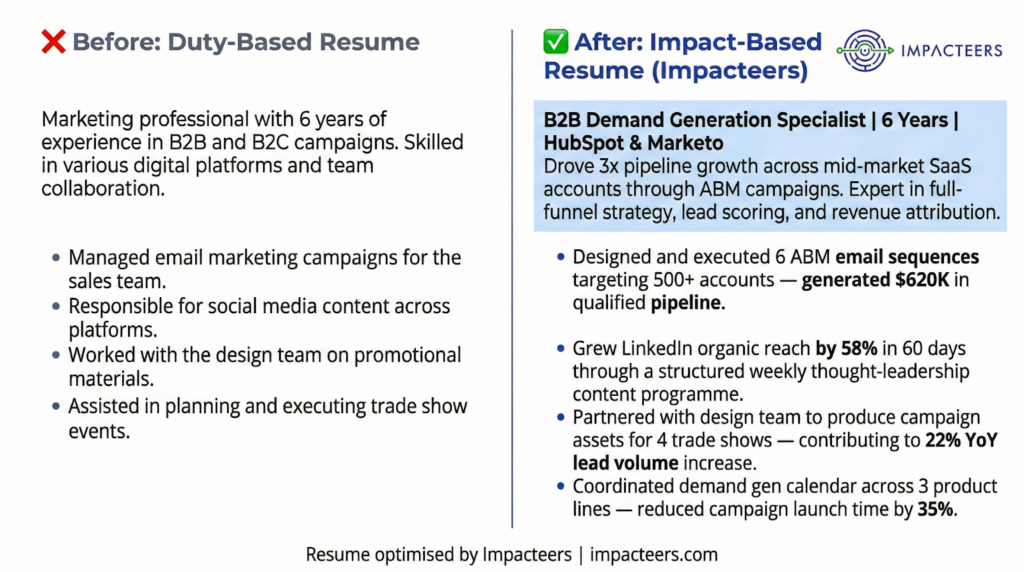
The Situation: A mid-level marketing professional with 6 years of experience had applied to 40+ roles and received zero callbacks. Her resume was well-formatted but listed only duties — no metrics, no impact language, and no keywords tailored to the roles she was targeting.
What Impacteers Changed:
- Rewrote the summary to position her as a “B2B demand generation specialist” — the exact language used in her target job descriptions.
- Added metrics to 8 experience bullets.
- Integrated 12 high-frequency industry keywords naturally.
The Outcome: She applied to 8 roles with the revised resume. She received 5 interview invitations within 12 days.
The resume did not change who she was. It finally told the truth about what she had achieved.
ATS Resume Mistakes Most Candidates Don’t Know
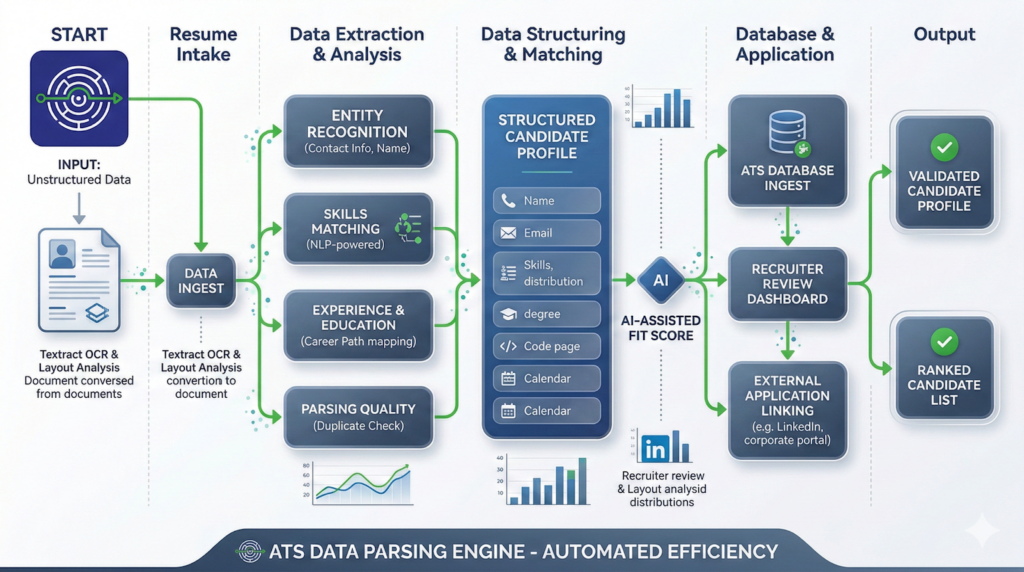
Most candidates believe their resume looks great. And visually, it might. But ATS systems do not see design — they see raw text. And when that text is locked inside tables, graphics, or complex layouts, the system simply cannot read it.
“We once had a brilliant candidate apply through our portal. Her resume came through as a series of broken characters and scrambled sections. She had used a two-column template. We nearly missed her entirely.”
— Impacteers HR Advisor
To understand the full rules, read our complete guide on how to write an ATS-friendly resume.
8) Fancy Templates That Break ATS Parsing
Those beautiful Canva and Pinterest resume templates are designed to impress the human eye — not the machine. Many of them use text boxes, columns, and image layers that ATS software simply cannot parse accurately. The result is a garbled, incomplete profile in the recruiter’s system.
Use clean, linear, single-column templates for any role where you are applying through an online portal — for a curated list of clean, ATS-safe designs, explore the resume templates guide from Impacteers.
9) Graphics, Icons, and Logos (Non-Text Elements)
Skill bars that show “Python: 80%” and visual icons next to your name look polished, but they are completely invisible to ATS software. The system reads text only. Icons and graphics consume space without contributing any searchable information to your profile.
Replace visual skill indicators with written skill descriptions embedded in your experience bullets.
10) Tables and Multi-Column Layouts
Many ATS systems parse left-to-right across the full page width. A two-column layout can result in your skills column and your experience column being merged into a confusing, single line of text. Your contact information could end up next to your job title from 2019. It is a parsing disaster.
Single column. Always.
11) Information in Headers and Footers
Contact details, LinkedIn URLs, or certifications placed in the document header or footer are frequently skipped by ATS software. This means your phone number and email — the most critical pieces of information on the entire document — could be completely absent from your candidate profile.
Place all contact information in the main body of the document.
12) PDF vs Word: Choosing the Wrong File Type
The debate between PDF and Word is actually quite simple in practice. If the job portal does not specify, a standard .docx file is the safer choice for ATS compatibility. PDFs, while visually consistent, can sometimes cause extraction errors in older or less sophisticated systems.
However, if the employer specifies a format — always follow that instruction.
13) Keyword Stuffing
Some candidates attempt to game the ATS by pasting long lists of keywords into a “hidden” section in white text, or by repeating terms excessively. Sophisticated 2026 systems detect this pattern and flag your profile as spam.
Keywords must be contextual — embedded inside achievement bullets that describe real work. Authentic keyword integration is the only sustainable strategy.
How ATS Parsing Actually Works
Here is a simplified breakdown of what happens the moment you click “Submit Application”:
What the ATS Scans For
The system strips all formatting and converts your document to plain text. It then looks for recognizable section headers — “Work Experience,” “Education,” “Skills” — to categorize your data. Next, it scans for keywords that match the recruiter’s search criteria, which are usually pulled directly from the job description.
Common Parsing Failure Points
- Non-standard fonts that corrupt during text extraction
- Unique section labels like “My Journey” instead of “Work Experience”
- Text boxes and tables that merge during parsing
- Headers/footers that are skipped entirely
| ATS-Safe Element | Recommended Standard |
| Section Headers | Work Experience, Education, Skills, Certifications |
| Layout | Single column, no text boxes |
| Font | Arial, Calibri, or Times New Roman |
| File Type | .docx unless PDF is specified |
| Date Format | MM/YYYY consistently across all roles |
Resume Formatting & Structural Mistakes
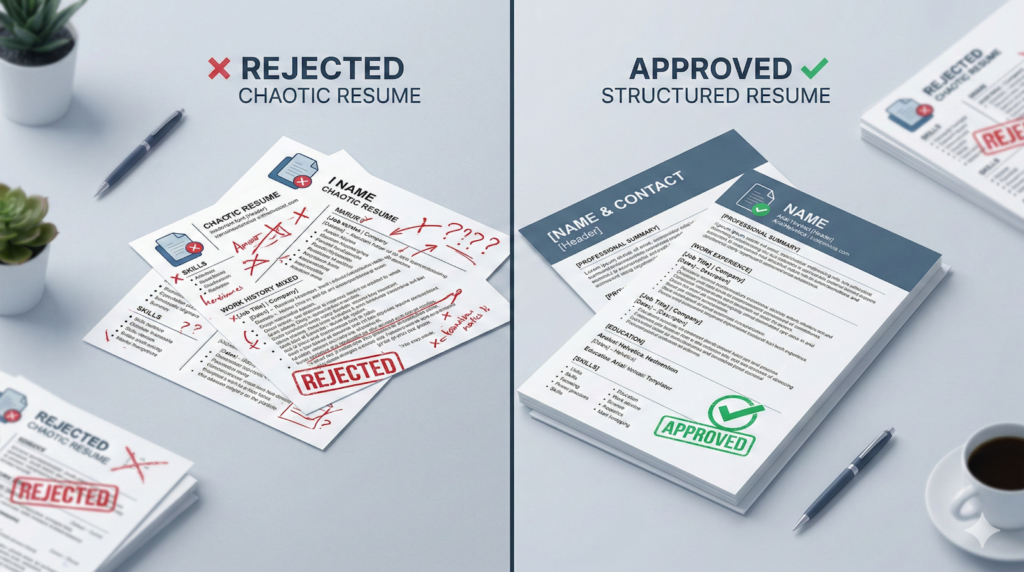
Great content in a poor structure is like a strong product in a broken package. The structure of your resume determines how quickly your value is discovered — and how much of it survives the ATS and the recruiter’s 6-second scan.
14) Too Long
A three-page resume from a mid-level professional tells me two things: you struggle to prioritize, and you are not writing for the reader. Every line of your resume should justify its presence with relevant, recent, and impactful information.
The standard: 1 page for freshers, 2 pages for professionals with 5–15 years of experience, and a carefully curated 2–3 pages for senior leaders only.
15) Too Short
On the flip side, a half-page resume from an experienced professional leaves me with more questions than answers. If your document is sparse, it signals either a lack of achievement depth or a lack of effort in presenting your career.
Fill every section with relevant proof — projects, certifications, volunteer leadership, or side-work that demonstrates competence.
16) Dense Paragraphs
Long, unbroken paragraphs under your experience sections are the fastest way to lose a recruiter’s attention. People do not read resumes the way they read articles. They scan for anchors — bold terms, action verbs, and numbers.
Bullet points are not just a formatting preference. They are a strategic tool for controlling where the reader’s eye goes.
17) Weak Bullet Structure
Bullets that begin with passive language — “Responsible for,” “Helped with,” “Assisted in” — project a narrative of someone who participates, not someone who leads. Your word choice at the beginning of each bullet is a micro-signal about your professional confidence.
Strong action verbs to use: Spearheaded, Engineered, Delivered, Accelerated, Reduced, Generated, Launched, Transformed, Optimized.
18) Inconsistent Tense
Mixing past and present tense within the same section is a subtle but clear sign of an unpolished document. It suggests the resume was written hastily or in multiple disconnected sessions without a final cohesive review.
The rule: Past tense for all previous roles. Present tense only for your current role if you are still employed there.
19) Wrong Resume Format
| Candidate Situation | Best Format | Why It Works |
| Steady career growth | Chronological | Clearly shows progression |
| Career pivot or industry change | Hybrid | Highlights transferable skills first |
| Significant employment gaps | Hybrid | Controls the narrative |
| Fresh graduate | Chronological (education-led) | Maximizes academic and project proof |
To pick the right one for your situation, read the resume format guide from Impacteers.
Strategic Resume Mistakes Professionals Make
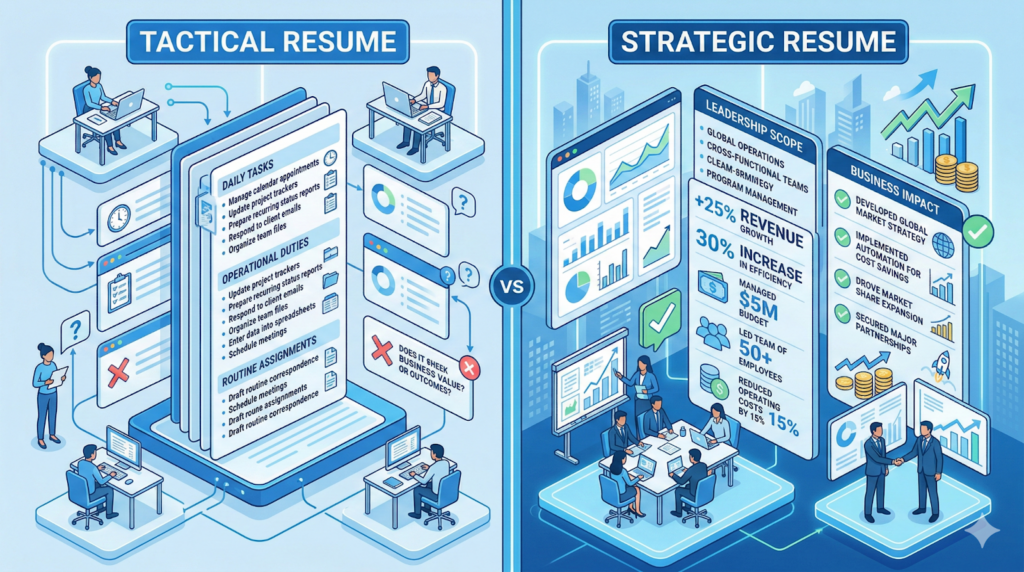
This section is for the experienced professional who has already corrected the basics but is still not getting the caliber of interviews they expect. These mistakes are subtler, but they carry significant weight at the mid-to-senior level.
20) No Career Narrative
A sequence of jobs is not a career story. If your resume reads like a list of disconnected experiences with no visible thread connecting them, a hiring manager is forced to build that story themselves — and they usually will not bother.
Your resume must answer a quiet but powerful question in the recruiter’s mind: “Why does this person’s entire career lead to this role?”
Connect your experiences with a clear directional narrative in your summary and through the consistent vocabulary you use across roles.
21) No Value Proposition
A value proposition is the one-line answer to the question: “What specific business problem do you solve better than most?”
Without this, you are a generalist in a market that rewards specialists. Define your unique professional identity early in the document — ideally in the summary — and then prove it across every role that follows.
22) No Leadership Metrics
“When I am hiring for a senior role, I need to see evidence of scale. How big was your team? What budget did you manage? How many stakeholders were you influencing? If those numbers are not on the resume, I have to assume they are not impressive.”
— Impacteers Senior Recruiter
Leadership is measured through scope. Document team size, budget ownership, cross-functional reach, and the organizational level of the stakeholders you worked with.
23) Weak Executive Positioning
Senior professionals frequently make the mistake of writing “doing” resumes instead of “directing” resumes. If you led strategy, say so. If you influenced board-level decisions, say so. If your roadmap shaped the product for three years, say so.
The language shift from “I managed” to “I defined” or “I architected” is not arrogance. It is accurate professional positioning.
24) Not Tailoring Per Industry
Finance, healthcare, technology, and consulting each have their own vocabulary, their own metrics, and their own definition of what “strong performance” looks like. Submitting a resume built for one industry to a role in another is a common and costly mistake.
Research the 10 most common terms used in senior job descriptions within your target industry. Integrate them naturally into your language.
Resume Mistakes by Experience Level
Freshers / Entry-Level
Starting your career is intimidating, and I genuinely feel for candidates at this stage. The challenge is proving your capability when you have limited professional experience. Here is the truth: you have more to show than you think.
No Projects
Academic and personal projects are your portfolio. Treat them with the same seriousness as a professional role — include the tools used, your specific contribution, and the outcome or purpose of the project.
No Internships
If you have completed internships, they deserve their own section with achievement-based bullet points. “Completed a 3-month internship” is not a bullet. “Developed a lead qualification dashboard in Power BI used by the sales team to reduce manual reporting time by 4 hours per week” is.
No Skill Proof
Listing “Python” or “Graphic Design” without any accompanying evidence is a claim without a foundation. Add a GitHub link, a Behance portfolio, a published article, or a Kaggle project. Make your skills verifiable.
Mid-Level Professionals
At this stage, you are no longer a learner — you are expected to be a driver. Your resume must reflect that shift in identity.
No Impact Metrics
You have delivered real results in your career. The question is whether your resume communicates them clearly. Audit every bullet point and ask: “Does this prove I moved a number that mattered to the business?”
No Growth Progression
Recruiters look for an upward arc. If you held the same title for 5 years with no change in scope, address it proactively through expanding responsibilities, teams mentored, or new domains mastered.
Senior-Level / Leadership
At the senior level, your resume is essentially a business case for why you are worth the investment.
No Strategic Achievements
List the initiatives you originated, not just managed. The difference between “oversaw market expansion” and “designed the 3-year market entry strategy that took the company from 2 cities to 14 with 340% revenue growth” is the difference between a coordinator and a leader.
No Revenue Impact
P&L responsibility, cost reduction, revenue generation, and risk mitigation are the pillars of senior value. If your work cannot be tied to a financial outcome, reframe it through scale, efficiency, or organizational risk.
| Experience Level | Primary Proof Type | Must-Have Elements |
| Fresher | Skill demonstration | Projects, internships, portfolio links |
| Mid-level | Delivery performance | Metrics, growth, ownership |
| Senior-level | Business impact | Strategy, revenue, leadership scope |
Resume Red Flags That Recruiters Notice Immediately
I want to be transparent with you: when a recruiter notices these signals, it creates doubt — and doubt kills shortlisting decisions faster than almost anything else.
Employment Gaps Unexplained
An unexplained gap does not automatically disqualify you. Life happens. What disqualifies you is the silence around it. A single honest line — “Career break: Full-time caregiving responsibility” or “Intentional pause for professional upskilling — completed [X] certification” — removes the ambiguity completely.
“I respect candidates who are honest about gaps far more than those who try to hide them with creative date formatting. Honesty signals integrity.”
— Impacteers HR Advisor
Overused Buzzwords
“Dynamic,” “Passionate,” “Team player,” “Results-driven.” These words appear on virtually every resume I review. They are so overused that they have lost all meaning. Prove these qualities through evidence, not adjectives.
If you are a team player, show me the cross-functional project you led. If you are results-driven, show me the metric that proves it.
Objective Statements in 2026
The objective statement belongs in 2005. It communicates what you want from the company at a time when the employer is trying to figure out what you offer them. Replace every objective statement with a strong, targeted professional summary.
Overdesign
I have seen resumes with sky blue backgrounds, three different fonts, circular profile photos, and design elements that look like they belong on a magazine cover. My reaction is always the same: where are the results?
A visually complex resume shifts the reader’s attention from your achievements to your design choices. Clean, minimal, and evidence-rich wins every time.
Resume Optimization Checklist
Run this checklist before every single application. Print it. Pin it above your desk. Make it a non-negotiable pre-submission ritual.
| Checklist Item | Why It Matters | Done? |
|---|---|---|
| Summary tailored to this specific role | Signals genuine interest and fit | |
| Core JD keywords integrated naturally | Improves ATS match score | |
| 50%+ of bullets contain a metric | Proves impact, not just effort | |
| Single-column, standard font formatting | Ensures ATS parsing accuracy | |
| All bullets begin with strong action verbs | Projects confidence and ownership | |
| Contact info in main body (not header/footer) | Prevents data loss in ATS | |
| Consistent tense and grammar throughout | Reflects communication discipline | |
| File format matches portal requirements | Prevents structural corruption | |
| Unexplained gaps addressed briefly | Removes recruiter doubt | |
| Proofread by at least one other person | Catches errors you are blind to |
Your resume transformation starts now.
Frequently Asked Questions
What are the biggest resume mistakes?
The most damaging mistakes are submitting non-tailored applications, writing responsibility-based bullets without metrics, and using templates that break ATS parsing. These three errors alone account for the majority of preventable rejections in competitive job markets.
How many pages should a resume be?
Freshers and early-career professionals should target one focused page. Mid-level professionals with 5–10 years of experience should aim for two pages. Senior leaders may go to three pages only if every section contains high-impact, role-relevant content. Padding is always worse than brevity.
Do recruiters prefer PDF or Word?
If the application portal specifies a format, follow that instruction without exception. If there is no guidance, a standard .docx file is generally safer for ATS compatibility. Modern, well-configured portals handle both well — but older systems still struggle with complex PDFs.
What resume mistakes cause the most rejections?
The four biggest rejection triggers are: spelling and grammatical errors, failure to mirror job description language, generic summaries that do not demonstrate role fit, and dense formatting that fails the 6-second readability test.
What ATS mistakes should I avoid?
Avoid multi-column layouts, tables, graphics, headers/footers for critical information, and keyword stuffing. Use standard section headings, clean single-column formatting, and integrate keywords contextually inside achievement bullets.
Final Thoughts From My Desk
After years in recruitment, I still believe the same thing I believed on day one: talent is everywhere, but opportunity is not always distributed fairly. The resume is one of the few things you can control completely in a job search. It is your first impression, your marketing document, and your proof of value — all in one.
The 25 mistakes in this guide are not character flaws. They are fixable problems. And fixing them, with the right guidance from Impacteers, is the difference between being invisible and being shortlisted.
Your next opportunity is closer than you think. The resume just needs to do its job.






Post Comment