Traditional workforce planning assumes environments remain stable.
Reality inside enterprise delivery ecosystems is the opposite — programs scale, scope pivots mid-cycle, niche capability clusters get saturated, and attrition rarely distributes evenly.
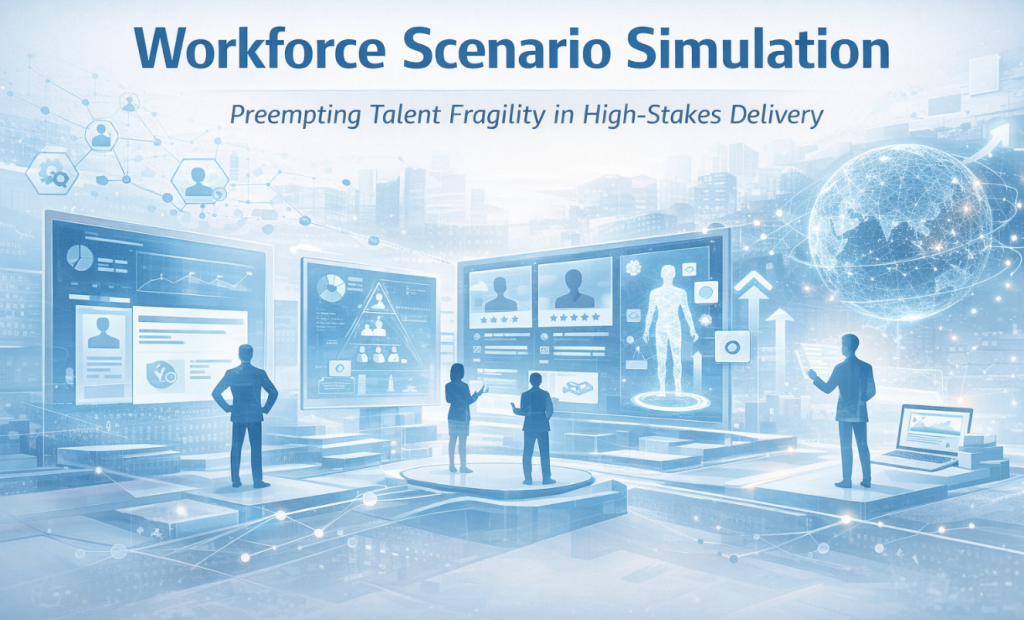
This is where Workforce Scenario Simulation is reshaping staffing, capability planning, and delivery-risk governance.
Instead of projecting headcount capacity, Workforce Scenario Simulation models:
- capability concentration ratios
- failure-prone dependency pods
- redeployment shock thresholds
- skill half-life impact on delivery continuity
Across BFSI transformation programs, IT services portfolios, and GCC operations, Workforce Scenario Simulation is increasingly being adopted as a pre-mortem risk instrument — allowing leaders to predict where delivery fragility will occur before it becomes a client escalation event.
Enterprises that have operationalized Workforce Scenario Simulation report:
- better bench allocation quality
- fewer last-minute hiring dependencies
- improved delivery stability during scaling cycles
because risk becomes quantified rather than discovered in hindsight.
Capability Stress Testing Through Workforce Scenario Simulation
The most mature implementations of Workforce Scenario Simulation use capability stress tests instead of role-based modeling.
These simulations evaluate:
- what happens if a niche skill pod loses 10–15% capacity
- which projects collapse when one senior SME exits
- how much redeployment friction a program can absorb
- which capability clusters are single-point-of-failure zones
In several India-based GCCs, Workforce Scenario Simulation revealed that capability fragility was not caused by headcount scarcity — but by over-centralization of expertise inside a handful of delivery pods.
Once identified, enterprises accelerated:
- cross-pod capability distribution
- redundancy hiring in critical skill bands
- structured mentoring bridges between talent layers
reducing escalation probability without increasing total headcount.
Attrition Shock Modeling in Workforce Scenario Simulation
Attrition is rarely catastrophic in volume — it is catastrophic in location.
Workforce Scenario Simulation now integrates attrition-shock modeling by mapping:
- historical churn clusters
- role-dependency networks
- project fragility probability
- recovery-time-to-stability curves
This allows HR and delivery leadership teams to ask:
“If we lose two senior architects in this pod — what fails first?”
In technology consulting programs, Workforce Scenario Simulation has helped identify accounts where attrition impact would ripple into:
- backlog compression
- velocity breakdown
- knowledge-transfer lag
The insight shifts attrition management from post-exit replacement to pre-exit risk insulation.
Redeployment Impact Analysis in Workforce Scenario Simulation
Rapid redeployment is often positioned as a productivity advantage — but when executed without context, it introduces hidden instability.
Through Workforce Scenario Simulation, enterprises analyze:
- dependency debt created by talent movement
- productivity lag across successive redeployments
- team-cohesion disruption thresholds
- client-delivery perception risk
One major engineering R&D program uncovered that repeated redeployment of a high-performing capability cluster led to systemic burnout risk, not resource optimization.
Post-simulation, redeployment rules were reframed around:
- recovery bands
- assignment rotation ceilings
- resilience buffers
resulting in sustainable delivery performance.
Deal Pipeline Readiness in Workforce Scenario Simulation
Forward-maturity organizations run Workforce Scenario Simulation before committing to large transformation deals.
Simulations model:
- surge capacity impact
- skill-availability gaps by wave
- reskilling lead-time requirements
- hiring dependency exposure
This allows leadership to answer questions like:
- Can capability scale without risk-stacking?
- Which pods require pre-emptive redundancy?
- Where does learning investment produce insulation?
Enterprises using Workforce Scenario Simulation in deal-qualification cycles report significantly stronger win-to-delivery stability alignment — reducing early-phase performance shocks.
Governance & Decision Intelligence in Workforce Scenario Simulation
The strongest outcomes occur when Workforce Scenario Simulation is embedded as an institutional governance layer — not a tactical analysis tool.
High-trust operating models include:
- joint ownership across HR, COEs, and Delivery
- cross-functional risk-review forums
- simulation-linked investment decisions
- structured remediation playbooks
This reframes workforce planning as:
capability risk engineering — not headcount accounting.
Enterprises that institutionalize Workforce Scenario Simulation are better positioned to absorb disruption, scale programs responsibly, and sustain delivery credibility in complex, high-stakes environments.






Post Comment