The most mature AI adoption models in enterprise HR are not those that fully automate decision-making — but those that operationalize Human-in-the-Loop Talent Automation to blend algorithmic intelligence with contextual leadership judgment.
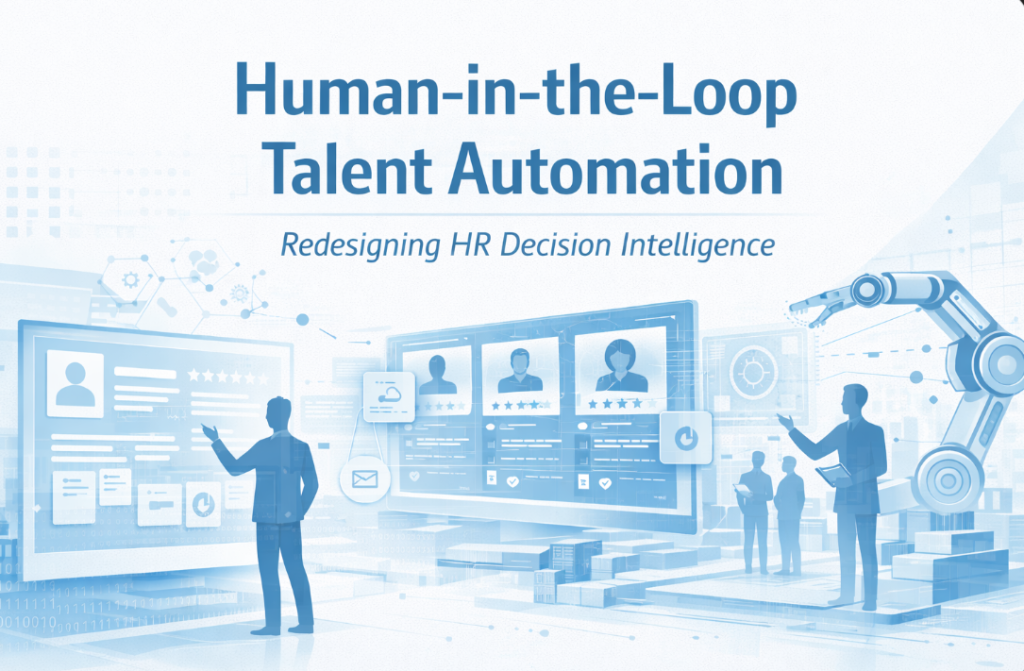
Unlike traditional workflow automation, Human-in-the-Loop Talent Automation integrates:
- recommendation engines rather than rule engines
- explainable allocation logic instead of opaque scoring
- human override checkpoints for high-risk outcomes
- continuous feedback loops from delivery environments
Across GCCs, consulting delivery ecosystems, and BFSI transformation programs, Human-in-the-Loop Talent Automation is emerging as the default operating paradigm — not because AI is insufficient, but because talent decisions require contextual nuance that pure algorithms cannot interpret.
Multiple workforce AI adoption studies report that enterprises implementing Human-in-the-Loop Talent Automation experience:
- higher stakeholder trust during AI-enabled staffing
- stronger acceptance of allocation recommendations
- reduced model resistance and rollout friction
Trust — not automation — becomes the real performance differentiator.
Staff Deployment Models in Human-in-the-Loop Talent Automation
The most advanced Human-in-the-Loop Talent Automation environments blend:
- AI-generated staffing recommendations
- team-fit and delivery-environment heuristics
- historical collaboration resilience patterns
- human-validated final deployment choice
Instead of replacing staffing specialists, AI acts as a decision amplifier.
In large IT services delivery programs, Human-in-the-Loop Talent Automation helped:
- reduce time-to-staff critical pods
- avoid false-fit placements flagged by human reviewers
- prevent productivity dip during rapid redeployment cycles
AI surfaces capability candidates.
Humans interpret delivery context.
This dual-layer decision model preserves performance integrity — particularly during scaling or transformation phases where workforce fragility is highest.
Bias Mitigation Through Human-in-the-Loop Talent Automation
Ironically, one of the strongest ethical advantages of Human-in-the-Loop Talent Automation is bias reduction — not bias reinforcement.
High-governance systems embed:
- bias checkpoints at recommendation stage
- explainability layers on model outputs
- role-to-candidate justification mapping
- override reasoning capture for audit trails
Rather than trusting AI blindly, Human-in-the-Loop Talent Automation forces organizations to interrogate decision logic — making staffing outcomes more transparent and defensible.
In Indian GCC environments, this has strengthened workforce trust while enabling leaders to operationalize AI without triggering cultural pushback.
Performance Feedback Loops in Human-in-the-Loop Talent Automation
Traditional automation systems end at task completion.
Human-in-the-Loop Talent Automation extends into post-deployment learning.
Performance signals fed back into the system include:
- onboarding ramp-time differentials
- first-assignment delivery quality
- collaboration friction markers
- attrition-probability drift
These signals continuously retrain recommendation models — allowing Human-in-the-Loop Talent Automation to improve accuracy without losing interpretability.
Enterprises report the strongest ROI in:
- multi-pod delivery ecosystems
- global program portfolios
- transformation-heavy environments
where staffing accuracy compounds into contract stability and revenue assurance.
Operating Governance for Human-in-the-Loop Talent Automation
Organizations that succeed with Human-in-the-Loop Talent Automation treat it as an operating model — not a tool rollout.
Mature governance structures include:
- dual-ownership between HR & delivery leadership
- risk-tiered decision thresholds for override escalation
- formal “human responsibility checkpoints”
- structured annotation of reviewer insights
This creates institutional accountability while preserving room for expert judgment — especially in mission-critical staffing scenarios.
Where governance is weak, AI adoption fails — not due to technical inaccuracy, but due to credibility collapse inside the workforce.
Where Human-in-the-Loop Talent Automation Delivers Highest Impact
Enterprise use cases showing strongest outcomes include:
- high-stakes staffing for program transformation pods
- niche-skill deployment in fragile delivery environments
- rapid redeployment during contract reprioritization
- succession mapping in capability-critical teams
Across these scenarios, Human-in-the-Loop Talent Automation improves:
- staffing precision
- workforce trust
- outcome predictability
The future of HR is not AI versus humans — it is AI alongside humans as co-decisioning partners in complex workforce systems.






Post Comment