The next phase of enterprise HR transformation is being shaped by AI-Driven Workforce Planning, where workforce models behave like living, continuously adapting systems rather than static headcount spreadsheets. In India’s GCC ecosystem and global B2B enterprises, leadership conversations are shifting from “how many roles do we need” to “what capability lattice sustains delivery resilience over the next 12–18 months.”
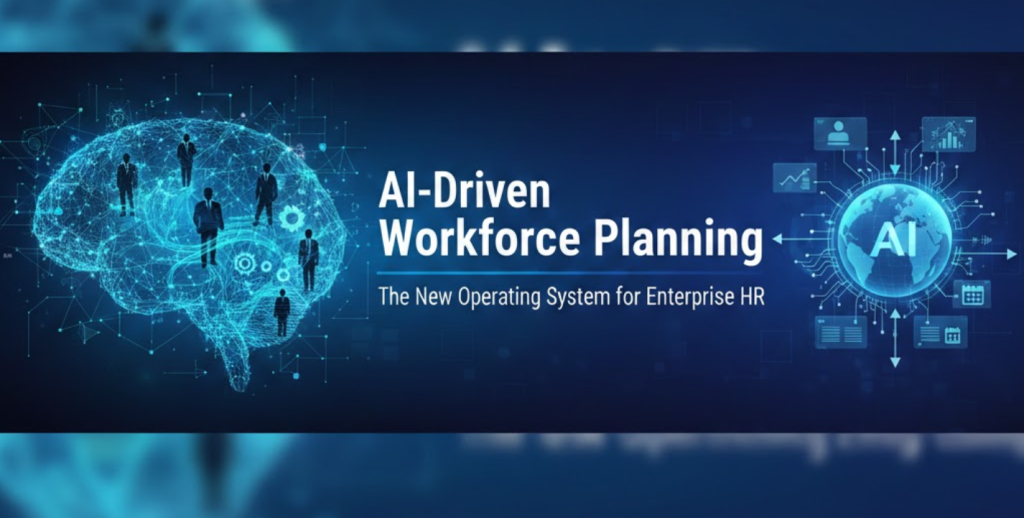
In high-maturity organizations, AI-Driven Workforce Planning acts as a strategic control tower — integrating staffing demand signals, capability graphs, performance markers, and deployment readiness into a unified decision layer.
According to multiple global talent transformation studies across BFSI, technology services, and manufacturing GCCs, AI-based capability mapping has reduced time-to-billable and bench variance by double-digit percentages — particularly in hybrid delivery environments.
Capability Graphs in AI-Driven Workforce Planning
Instead of traditional skill matrices, enterprises are now building capability graphs that map skills, adjacencies, learning velocity, utilization history, and project outcomes into a networked knowledge model. Within these ecosystems, AI-Driven Workforce Planning systems identify:
- latent capability clusters hidden inside delivery units
- reskilling corridors with the highest value-realization potential
- at-risk delivery pods where attrition + backlog create fragility
- redeployment vectors that replace hiring with capability mobility
In several Indian IT services organizations, capability-graph-led staffing has enabled faster squad restructuring during contract pivots — without triggering productivity loss or institutional knowledge leakage.
Predictive Demand Signals in AI-Driven Workforce Planning
Conventional manpower forecasting relies on historic staffing cycles. In contrast, AI-Driven Workforce Planning ingests multi-signal inputs such as:
- probability-weighted deal pipeline curves
- renewal sentiment from client success analytics
- macro-sector hiring volatility trends
- delivery backlog stress indicators and capacity heatmaps
This allows HR and business leadership to move from quarterly planning to rolling micro-forecasting cycles.
The real advantage is not speed — it is decision precision: AI distinguishes between temporary demand spikes that require redeployment vs. structural capability gaps that justify hiring or strategic upskilling.
Global COEs adopting AI-Driven Workforce Planning report measurable improvements in utilization stability and bench compression, especially in program-heavy enterprise environments.
Talent Liquidity & Deployment Readiness
One of the most transformative outcomes of AI-Driven Workforce Planning is talent liquidity — the ability to move capability to value-creation contexts without disrupting delivery cadence.
Advanced deployment engines now incorporate:
- collaboration compatibility and team-fit indicators
- learning half-life of technical stacks
- readiness-to-transition bands
- role-environment resilience characteristics
GCCs using these models have reduced shadow benches and improved delivery continuity during rapid project re-scoping — a recurring challenge in enterprise transformation programs.
Capability is no longer treated as inventory — it becomes circulating economic value.
Governance, Explainability & Ethical Workforce AI
The success of AI-Driven Workforce Planning is as much institutional as it is technical. High-trust implementations embed:
- explainable allocation logic
- role-based visibility boundaries
- auditable movement trails for compliance
- joint governance between HR, business, and delivery leadership
Where governance discipline is weak, AI programs stall — not due to algorithmic failure, but due to organizational trust erosion.
What Leading Enterprises Are Doing Differently
Forward-maturity HR organizations are:
- replacing JD-driven hiring with capability taxonomies
- funding reskilling as a capacity-creation asset, not a cost center
- simulating workforce structures before major deal closures
- aligning learning ecosystems to predicted deployment corridors
Enterprises that operationalize AI-Driven Workforce Planning build a compounding strategic advantage — where capability creation, deployment precision, and value realization operate in a single cognitive loop.






Post Comment